
A relative newcomer compared to marine compasses, with equally demanding requirements given the speed of travel and the fact that there is often a lot of metal and equipment around the compass. The distances travelled in one journey means that the earth’s magnetic field deviation changes during the route.
Some of the earliest work on compasses for aircraft was undertaken by the Compass Department of the British Admiralty under the guidance of Captain F Creagh-Osborne R.N. Great Britain who was recognised at the time as a leader in the field of aircraft compasses. The Air Ministry was responsible for the Royal Airforce from 1914 to 1964.
In 1915 a second edition of a book titled “The Magnetic Compass in Aircraft” by Captain F Creagh-Osborne R.N. was published by Edward Arnold. The book explains the practicalities of using a compass in an aircraft, paying a lot of attention on the effects of deviation, which by this time was well understood in the marine field. The book explores the issues more specifically in the confines of an aircraft, which is travelling a lot faster than boats of that period did. The book makes the distinction between the Aircraft compasses and Observer’s compasses. Creagh-Osborne commissioned Messrs Hughes & Son to address many of the issues experienced in aircraft during the early part of WWI, the Type 5/17 was the result of this and this became the main compass used in the latter part of WWI. This functional distinction for compasses disappeared after WWII. During WWII British Pilot’s compasses were denoted P series and Observer’s compasses O series.
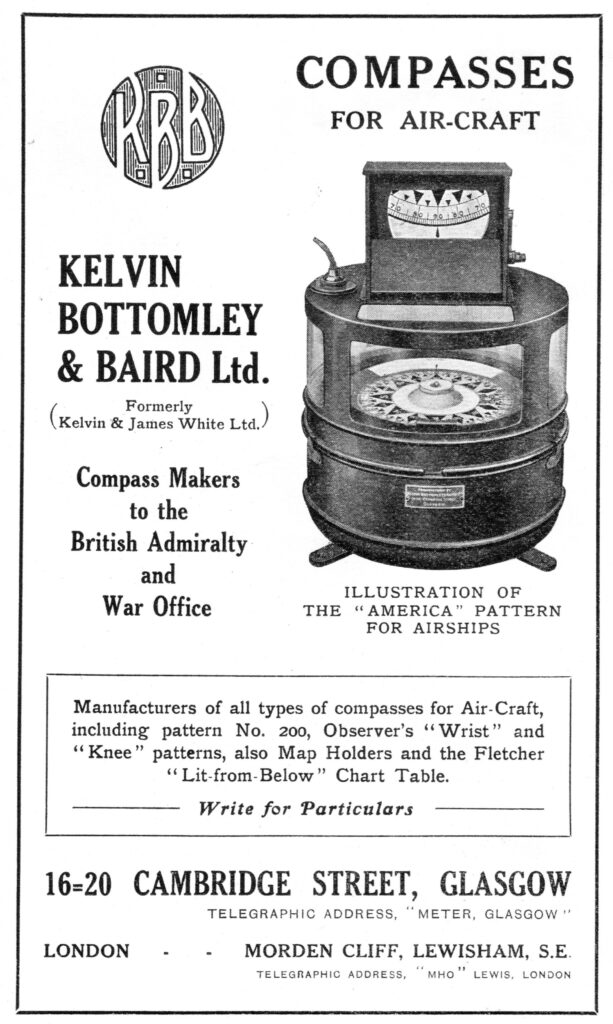
Aviation compasses of this period were used in both Aircraft and Airships.
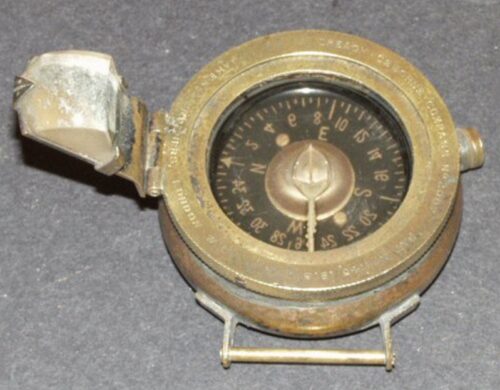
The main examples of aircraft compasses that have survived from the WWI period are Observer’s compasses that feature a leg strap and a prism for reading the direction.
By the WWII British compasses had evolved enough to allow more choice for magnetic compasses and for longer distances there were available Astro and Gyro compasses. Both are unaffected by magnetic fields. The Astro compass uses celestial bodies to establish a bearing, whilst the Gyro compass (based on the gyroscope) is able to give bearings relative to True North.
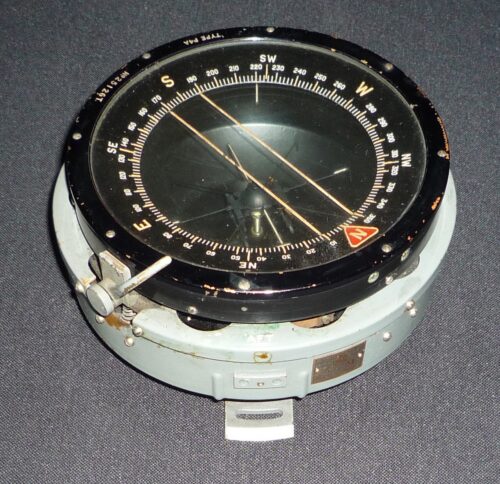
During WWII several British aircraft compasses were available, known as the P series compasses and are in general not dissimilar across the different models. By WWII aircraft compasses no longer used gimbals, were usually liquid damped, had a rotating bezel with a pair of grid steering lines for setting the course and were able to have correction magnets fitted. Smaller versions and roof mounted versions were also available. The words Air Ministry were used during WWII and will be found on the compass case. There is a detailed description of all these compasses in a booklet “RAF Compasses 1939-1945 Plus E2”, also a helpful explanation on the Compass Museum website.
Observer compasses continued to be available, in addition to landing compasses and bomb sight compasses.
Bomb sight Type D compasses are actually part of a Bomb sight system, frequently found by themselves they are of little use.

WWII saw the introduction of the Astro Compass. This enabled star and sunsight’s to be taken so that position could be calculated.

The great advantage of this instrument was that it was unaffected by deviation or variation on aircraft and unlike the Gyro compass did not need a power supply. It did need skill to use and was of great use on longer flights where there would be a navigator on board.
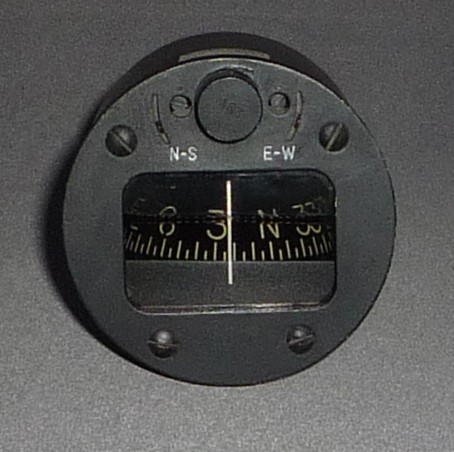
Post WWII the magnetic compass was evolved further and later designs even included built in compensators.
Reference Sources
The Magnetic Compass in Aircraft 2nd Edition, published by Edward Arnold, 1915, Author Captain F Creagh-Osborne, R.N.
RAF Compasses 1939-1945 plus E2, publisher unknown, available on Ebay.
Steady As She Goes – A history of the Compass Department of the Admiralty, published by HMSO, author A E Fanning, ISBN 0 11 290425 4.
The Compass Museum section on Aero Compasses https://www.compassmuseum.com/aero/aero.htm#AERO_COMPASS